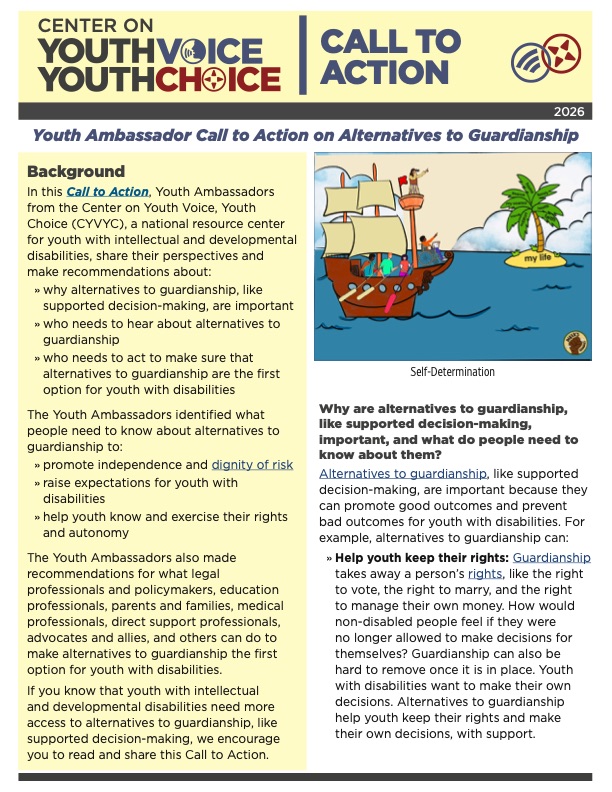
What is the Call to Action and why is it important?
Read the Call to Action Document
What is the Center for Youth Voice, Youth Choice (CYVYC)?
The Center for Youth Voice, Youth Choice (CYVYC) is a national resource center for youth with disabilities. CYVYC promotes the use of alternatives to guardianship by and for youth with intellectual and developmental disabilities (IDD). CYVYC supported 11 State Teams to create and implement action plans to advance alternatives to guardianship in their States.
A central part of the Center on Youth Voice, Youth Choice (CYVYC) is its Youth Ambassador program. The Youth Ambassador Program involved State Teams recruiting youth with IDD, ages 14 to 26, who were trained and supported to advance state-level change to promote alternatives to guardianship in their states. Over five years, CYVYC supported 41 Youth Ambassadors from 11 states.
CYVYC’s work was informed by a National Coalition, which brought together leadership organizations that represent youth with IDD, parents, caregivers, educators, advocates, and adult support systems to share information, knowledge, and access to alternatives to guardianship for young adults with IDD. CYVYC’s work was also informed by an Advisory Board that was made up of youth with IDD and other advocates that helps guide CYVYC’s work.
CYVYC’s project partners included:
- Institute for Community Inclusion
- Center for Public Representation
- Self Advocates Becoming Empowered
- Human Services Research Institute
- Georgia Advocacy Office
- Harvard Law School Project on Disability
Creating the Call to Action
As the five-year CYVYC project was ending, the CYVYC team wanted to create a document that could harness the power of Youth Ambassadors’ voices and propel advocacy on alternatives to guardianship forward into the future. We thought that the world should know about and listen to what youth with disabilities believe should happen next to promote alternatives to guardianship – what reforms are needed – and where our advocacy is most needed.
The Youth Ambassador Working Group, which consisted of partners from ICI, SABE, CPR, GAO, and HPOD, reached out to Youth Ambassadors about creating this Youth Ambassador Call to Action. This Working Group held three focus groups to get input from Youth Ambassadors about what should be in the Call to Acton. In these focus groups we asked the Youth Ambassadors questions like: What do people need to know about alternatives to guardianship and why they are important? Who needs to hear about them? And do what those people need to do to make alternatives to guardianship the first option for youth with disabilities?
We created a draft Call to Action and shared it with the Youth Ambassadors and incorporated their feedback. We also shared the draft with the Advisory Board and our CYVYC Partners. One Youth Ambassador, Derek Heard, added illustrations the Call to Action.
Overall, a total of 12 Youth Ambassadors from 8 State Teams participated in creating the Call to Action.
Why is this Call to Action important?
This Call to Action is important because it is youth’s own words about why alternatives to guardianship are important. It tells advocates and allies, what youth believe should happen next and inform advocacy going forward. One Youth Ambassador shared: “I think this Call to Action is important because us disabled people are just as capable of making our own decisions as non-disabled people.”
What do we want people to do with the Call to Action?
We want people to read it, share it, and use it to inform their advocacy going forward. The Call to Action makes specific recommendations about what the following groups of people should do to advance alternatives to guardianship:
- Legal professionals and policymakers
- Education professionals
- Parents and families
- Medical professionals
- Direct support professionals and service providers; and
- Advocates and allies
People who are looking to make change and advocate for alternatives to guardianship, should use this Call to Action to inform their work. Please share it widely with your communities, especially those who can advocate to advance the rights and self-determination of people with disabilities.